After 15 years under Tim Cook, Apple is changing hands. On April 28, 2026, Apple officially confirmed that John Ternus becomes Apple’s new CEO effective September 1, 2026. Cook, who took over from Steve Jobs in 2011, will move into a newly created role as Executive Chairman of Apple’s Board of Directors.
The announcement was unanimously approved by Apple’s Board. Ternus will also join the board of directors when the transition completes on September 1. It’s the most significant leadership change at the world’s most valuable consumer technology company in over a decade — and the man stepping in has spent nearly his entire professional life at Apple.
In this article, you’ll learn:
- Who John Ternus is and how he rose through Apple’s ranks
- What his engineering background means for Apple’s product future
- How this transition compares to previous Apple CEO changes
- What Tim Cook will do next
- What analysts and insiders are saying about the new Apple era
Who Is John Ternus? The Engineer Who Built Apple’s Hardware
John Ternus is 50 years old and has worked at Apple for 25 years — almost exactly half his life. He grew up in California, attended the University of Pennsylvania, and graduated in 1997 with a bachelor’s degree in mechanical engineering. At Penn, he competed on the men’s swimming team and built a mechanical feeding arm for people with quadriplegia as his senior project. That detail tells you something about the kind of engineer he is.
After college, Ternus spent four years at Virtual Research Systems, a California company working on virtual reality headsets. In hindsight, that experience — early VR hardware, display technology, human-computer interfaces — looks like ideal preparation for later work on Apple Vision Pro.
John Ternus’s Career at Apple: From Monitors to CEO
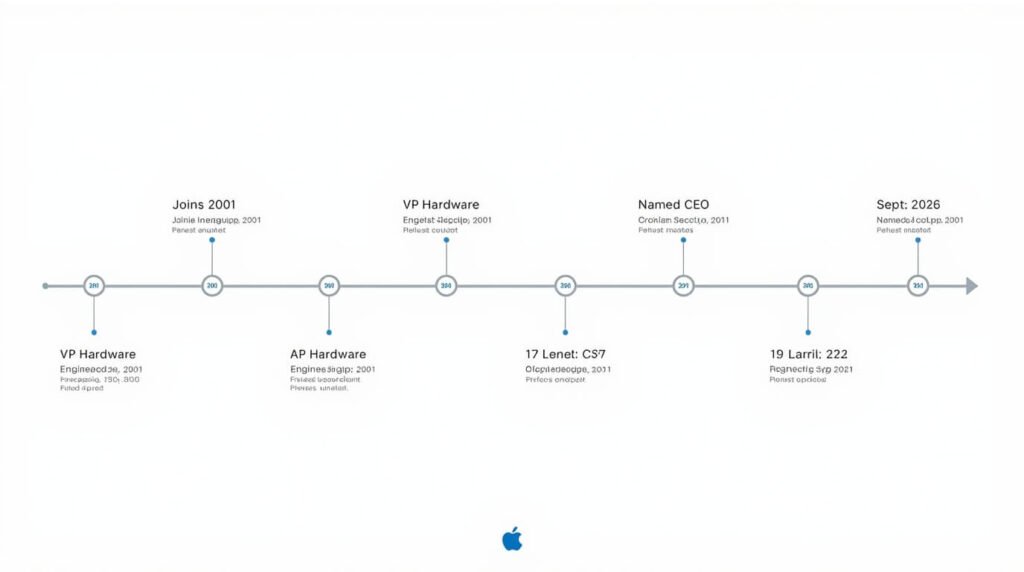
Ternus joined Apple in 2001 as a member of the product design team. His first project was the Apple Cinema Display — an external monitor. Not exactly a flashy entry point. But from there, the responsibilities compounded steadily.
By 2013, he was appointed Vice President of Hardware Engineering under Dan Riccio, overseeing AirPods, Mac, and iPad development. In 2020, he took on iPhone hardware as well — previously Riccio’s personal domain. In 2021, Ternus was promoted to Senior Vice President of Hardware Engineering, replacing Riccio on the executive team and becoming the youngest member of Apple’s leadership group.
Bloomberg’s Mark Gurman, who has covered Apple’s internal dynamics for years with a strong track record, described Ternus as “charismatic and well-liked” — a notable description for a hardware engineer who spent most of his career out of the public spotlight.
The Products Ternus Built: His Fingerprints Are Everywhere
When you pick up an iPhone, open a MacBook, put in AirPods, or strap on an Apple Watch, you’re holding something Ternus had a direct hand in. His 25-year tenure at Apple includes oversight over more product lines than almost anyone else in the company’s history.
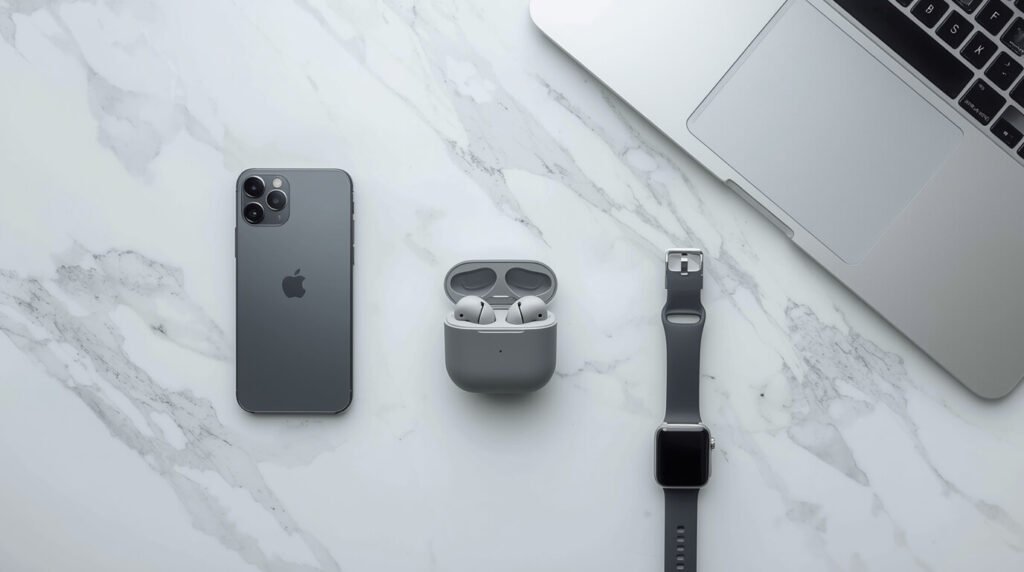
According to Apple’s official announcement, Ternus was instrumental in the introduction of iPad and AirPods as new product lines. He also oversaw the Mac’s transition to Apple silicon — one of the most technically complex and commercially successful platform transitions in the company’s recent history. The M-series chips now power the Mac lineup, and that shift from Intel happened under his hardware engineering leadership.
His team’s work on sustainability is also notable. Ternus led much of Apple’s innovation in materials and hardware design, including the creation of a recycled aluminum compound introduced across multiple product lines, the use of 3D-printed titanium in Apple Watch Ultra 3, and improvements in repairability that have extended the lifespan of several Apple products.
More recently, his team introduced the MacBook Neo — described in Apple’s announcement as making the Mac experience more accessible globally — and the iPhone 17 Pro and Pro Max lineup.
Tim Cook’s Reaction and What He’ll Do Next
Tim Cook, 65, has led Apple since Steve Jobs stepped down in August 2011 — just weeks before Jobs passed away. Under Cook’s 15-year tenure, Apple became the first company to hit a $3 trillion market cap and subsequently a $4 trillion valuation. The iPhone 6 era, the Apple Watch launch, AirPods, Apple Silicon, Apple TV+, and the services business expansion all happened under his watch.
Cook said in Apple’s official statement that Ternus has “the mind of an engineer, the soul of an innovator, and the heart to lead with integrity and with honor,” calling him “without question the right person to lead Apple into the future.”
As Executive Chairman, Cook will continue engaging with policymakers globally and assist with certain external aspects of the company. He’s not disappearing — he’ll work closely with Ternus through the summer to smooth the handover before September 1.
Arthur Levinson, who served as Apple’s non-executive chairman for 15 years, will transition to Lead Independent Director on September 1.
What Changes With an Engineer in Charge
Tim Cook came from operations. He built his reputation at IBM and Compaq managing supply chains and inventory before Steve Jobs recruited him to fix Apple’s logistics in the late 1990s. His Apple tenure was defined by operational efficiency, global supply chain mastery, and the expansion of services revenue.
John Ternus is fundamentally different. He’s a mechanical engineer who spent 25 years solving physical problems — how to make a hinge stronger, how to fit a battery and chip into a chassis that’s 5mm thin, how to build a display that doesn’t crease when you fold it. The products are his first language.
Beyond product launches, Ternus had taken on responsibilities that extended well beyond traditional hardware engineering, influencing product roadmaps, features, and strategic decisions typically reserved for more senior executives. So this isn’t a pure engineer stepping into an unfamiliar boardroom role — he was already operating at that level.
What Analysts Think About John Ternus as Apple CEO
Fortune noted that the success of Ternus’s tenure may hinge on whether he can advance Apple’s China-plus-one strategy without triggering political or commercial backlash, given that Greater China contributed $64.3 billion in revenue for Apple in its 2025 fiscal year.
On the product side, analysts broadly see Ternus as well-positioned for what’s next. Apple is reportedly working on foldable devices, spatial computing expansions beyond Vision Pro, AI hardware integration, and home robotics. Each of these product categories involves exactly the kind of hardware complexity Ternus has spent his career solving.
At 51, Ternus mirrors Cook’s age when Cook became CEO in 2011 — positioning him for potentially a decade or more of leadership, a longevity factor that likely appealed to Apple’s board, who prefer stability in leadership transitions.
Apple CEO Timeline: How Ternus Compares to His Predecessors
| CEO | Tenure | Background | Key Era |
| Mike Scott | 1977–1981 | Operations / Management | Early Apple, Apple II |
| Mike Markkula | 1981–1983 | Marketing / Investor | Expansion phase |
| John Sculley | 1983–1993 | Marketing (Pepsi) | Mac launch, then decline |
| Michael Spindler | 1993–1996 | Sales / Europe | Difficult transition period |
| Gil Amelio | 1996–1997 | Engineering / Semiconductors | Pre-Jobs return |
| Steve Jobs | 1997–2011 | Co-founder / Vision | iPhone, Mac, iTunes, iPad |
| Tim Cook | 2011–2026 | Operations / Supply Chain | $4T valuation, services era |
| John Ternus | 2026– | Hardware Engineering | Next chapter |
Ternus will be Apple’s eighth CEO. He’s the first to come directly from hardware engineering since Gil Amelio — though the comparison largely ends there. Ternus has 25 years of deep Apple institutional knowledge that Amelio never had.
What John Ternus Said About Becoming Apple CEO
In Apple’s official press release, Ternus said: “I am profoundly grateful for this opportunity to carry Apple’s mission forward. Having spent almost my entire career at Apple, I have been lucky to have worked under Steve Jobs and to have had Tim Cook as my mentor.”
He continued: “I am humbled to step into this role, and I promise to lead with the values and vision that have come to define this special place for half a century.”
For a man who spent most of his career away from public-facing roles, it’s a measured, considered statement — not flashy, not overconfident. Which tracks with everything reported about his personality internally.
Frequently Asked Questions About John Ternus as Apple’s New CEO
Q: When does John Ternus officially become Apple’s CEO? John Ternus becomes Apple’s CEO on September 1, 2026. Apple announced the transition on April 28, 2026. Tim Cook will remain in the CEO role through the summer to work closely with Ternus on the handover before the official transition date.
Q: What is John Ternus’s background? Ternus holds a bachelor’s degree in mechanical engineering from the University of Pennsylvania (class of 1997). He worked briefly at Virtual Research Systems designing VR headsets before joining Apple in 2001. He rose through hardware engineering roles, becoming SVP of Hardware Engineering in 2021 — the position he held until being named CEO.
Q: What products did John Ternus oversee at Apple? Ternus oversaw hardware engineering across virtually every major Apple product line, including iPhone, iPad, Mac, Apple Watch, AirPods, and Apple Vision Pro. He was central to the Mac’s transition to Apple silicon, the AirPods launch, and the most recent iPhone 17 lineup.
Q: What will Tim Cook do after stepping down as CEO? Tim Cook will become Executive Chairman of Apple’s Board of Directors on September 1, 2026. In that role, he’ll continue engaging with policymakers globally and support the company in an advisory capacity. He’s not leaving Apple — just stepping back from the day-to-day CEO responsibilities.
Q: Who replaced John Ternus as head of hardware engineering? Johny Srouji, previously Apple’s SVP of Hardware Technologies and the architect behind the M-series and A-series chips, was promoted to Chief Hardware Officer. He takes on an expanded role that absorbs Ternus’s former hardware engineering portfolio.
Conclusion: A New Chapter for the World’s Most Valuable Company
The transition from Tim Cook to John Ternus is not a crisis or a pivot — it’s the kind of deliberate, long-planned succession that Apple’s board takes seriously. Ternus has spent 25 years inside the company, built its most important products, and earned the trust of both Jobs-era veterans and Cook-era executives.
What changes is the emphasis. Cook’s Apple was about operational excellence, services growth, and scale. Ternus’s Apple will likely push harder on physical product innovation — foldables, spatial computing, home robotics, and whatever comes after the smartphone. His engineering instincts are the company’s north star now.
September 1, 2026 is when the title changes. But in many ways, John Ternus has been shaping Apple’s future for over a decade already.
For the official Apple announcement, see Apple’s Newsroom post on the leadership transition. For the SEC filing, the transition details are covered in Apple’s Form 8-K filed with the SEC.
Bookmark this page — we’ll update it as the September 1 transition date approaches.