
Red Delhi carrots are back in the sabzi mandi, which means one thing in most North Indian homes: a big kadhai of gajar ka halwa. So what do the gajar ka halwa calories look like per bowl? By our calculation for a typical home recipe, one katori has about 285 kcal and roughly 25 g of added sugar.
That 25 g matters more than the calories. It’s the whole day’s “ideal” sugar limit set by WHO, in one small bowl. The good news is that the carrots aren’t the problem, and section 4 shows how to cut the sugar in half and keep the halwa.
⚡ Key takeaways
- A classic katori (1/8 of a 1 kg carrot batch) works out to about 285 kcal, 25 g added sugar and 6 g saturated fat, using USDA values.
- WHO says free sugars should stay under 10% of daily energy, ideally under 5%: about 25 g or 6 teaspoons a day.
- A lighter version (toned milk, half the sugar, 1 tbsp ghee) comes to about 180 kcal and 12.5 g sugar per katori.
- Cooking carrots with some fat helps your body absorb beta-carotene, so a little ghee is fine.
- If you have diabetes or are watching your weight on medical advice, ask your doctor or dietitian how often halwa fits.
Gajar Ka Halwa Calories: How We Worked Them Out
There’s no single “official” number for gajar ka halwa calories, because every family makes it differently. So we took a common home recipe and added up each ingredient using USDA FoodData Central values.
The recipe: 1 kg carrots, 1 litre full-cream milk, 200 g sugar (about a cup) and 4 tablespoons of ghee (about 52 g). That batch is usually split into 8 katoris at home. Nuts and khoya aren’t counted, so treat our numbers as the minimum.
| Ingredient (whole batch) | Energy | Added sugar | Saturated fat |
|---|---|---|---|
| Carrots, 1 kg | ~410 kcal | 0 g (47 g natural) | ~0.3 g |
| Full-cream milk, 1 litre (~1,030 g) | ~628 kcal | 0 g (52 g natural) | ~19 g |
| Sugar, 200 g | ~774 kcal | ~200 g | 0 g |
| Ghee, 4 tbsp (~52 g) | ~468 kcal | 0 g | ~31 g |
| Whole batch | ~2,280 kcal | ~200 g | ~51 g |
| One katori (1/8) | ~285 kcal | ~25 g | ~6.3 g |
Look at where the gajar ka halwa calories actually come from. The carrots, a whole kilo of them, bring less than a fifth of it. Sugar and ghee together bring more than half.
This article is for information only; consult a doctor or dietitian if you have diabetes, heart disease or are on a prescribed diet.

The Real Issue Is the Sugar, Not the Carrots
The World Health Organization recommends keeping free sugars below 10% of daily energy. It adds that going below 5%, roughly 25 grams or 6 teaspoons a day, gives extra health benefits. Free sugars mean sugar added while cooking, plus honey, syrups and fruit juice.
India’s own guidelines line up with this. According to Krishi Jagran’s report on the ICMR-NIN Dietary Guidelines for Indians 2024, they advise people over two to keep sugar to 5% of daily calories, and children under two to have none.
So one classic katori uses up the whole “ideal” day of sugar, which matters more than the gajar ka halwa calories on their own. Add two cups of sweet chai and a couple of biscuits, and you’re heading for the 10% line before dinner.
What WHO doesn’t count
WHO’s limit doesn’t cover the sugar naturally present in vegetables and milk. That’s why the carrot and milk sugars in our table sit in brackets. The 200 g of white sugar is the part that counts.
💡 Pro tip
Switching to gur doesn’t change the maths. Jaggery is still added sugar, as our jaggery vs sugar check explains. Brown it in your halwa for taste, not for health.

What Carrots Actually Bring to the Bowl
Carrots deserve their winter reputation. USDA lists raw carrots at 41 kcal and about 8,285 µg of beta-carotene per 100 g. In our recipe, each katori holds roughly 125 g of carrot, before any cooking losses.
Here’s the part that surprises people: a bit of fat and cooking help. Beta-carotene is fat-soluble. In a small British Journal of Nutrition study (Ghavami 2012), researchers estimated that, compared with pure beta-carotene, about 11% was available from raw carrots and 75% from stir-fried ones.
A 2003 European Journal of Nutrition study found a similar pattern. Volunteers absorbed about 65% of the beta-carotene from cooked, pureed carrots, compared with 41% from raw, chopped ones. Both studies were small, so take the exact percentages loosely.
What this means for halwa: you don’t need 4 tablespoons of ghee for the carrots to “work”. One tablespoon cooked into the batch, with full milk or toned milk, already gives the fat that helps. Our carrots and eyesight myth check covers what beta-carotene can and can’t do.
The Lighter Gajar Ka Halwa: Same Kadhai, Half the Sugar
This is the swap that pays off the promise from the top, and it cuts gajar ka halwa calories by more than a third. You keep the carrots, the slow cooking and the cardamom. You change three things.
| Version | Milk | Sugar | Ghee | Per katori (1/8) |
|---|---|---|---|---|
| Classic | 1 L full-cream | 200 g | 4 tbsp | ~285 kcal, ~25 g sugar, ~6.3 g sat fat |
| Lighter | 1 L toned (2% fat) | 100 g | 1 tbsp | ~180 kcal, ~12.5 g sugar, ~2.6 g sat fat |
| Lighter, smaller katori (1/12) | 1 L toned | 100 g | 1 tbsp | ~120 kcal, ~8 g sugar |
We used USDA values for 2% milk (50 kcal per 100 g) as the closest match for Indian toned milk. Check the fat content on your milk packet, since brands differ.
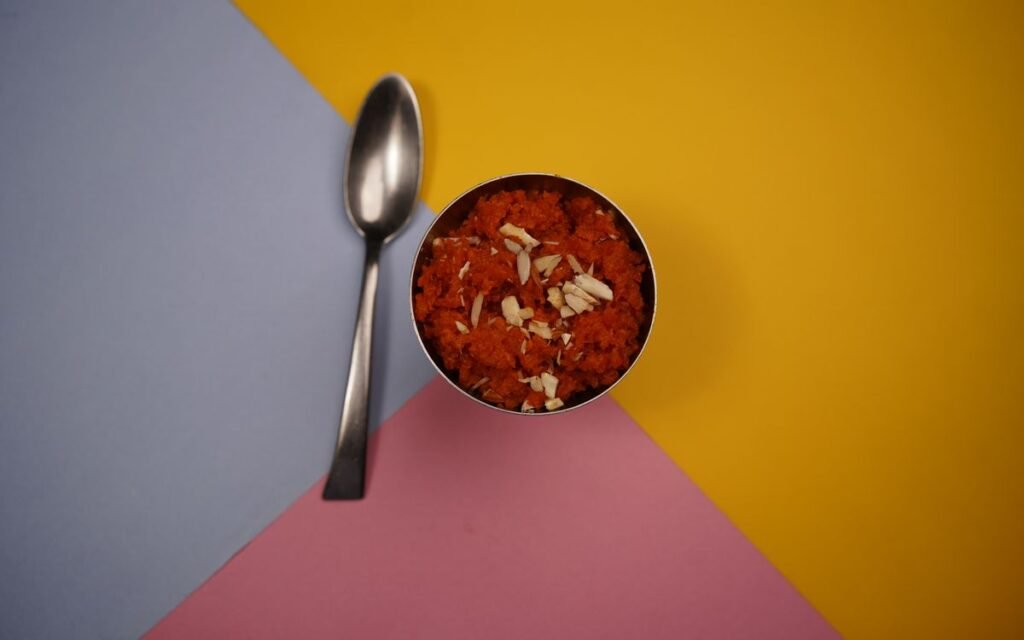
⚠️ Watch out
The calories that sneak back in are the extras: khoya, condensed milk, a fistful of cashews and a scoop of vanilla ice cream on top. Condensed milk is mostly sugar. If you add it, cut the plain sugar further.
Why halving the sugar still tastes fine
Winter carrots are already sweet. Our table shows a kilo carries about 47 g of natural sugar, and slow cooking in milk concentrates it. With less sugar on top, you taste more of the carrot itself. Start at 150 g if your household has a sweet tooth, then go down next time.
Step-by-Step: Make the Lighter Version
- Grate 1 kg of red carrots finely. Finer gratings cook faster and need less ghee to soften.
- Cook the carrots in 1 litre of toned milk on a low flame, stirring every few minutes, until the milk is almost gone. Be patient; in a heavy kadhai this can take well over half an hour.
- Add 100 g of sugar once the milk has reduced, and keep stirring until the halwa dries out again.
- Add 1 tablespoon of ghee and stir for 5 more minutes. This is when the halwa turns glossy.
- Finish with crushed cardamom and a small spoon of chopped almonds or pistachios per serving, not a handful for the whole kadhai.
- Serve in a smaller katori. A 1/12 portion is about 120 kcal.
💡 Pro tip
Freeze half the batch in small boxes. When halwa sits in the fridge in one big dabba, “just one more spoon” happens every time someone opens the door.
 Also readHow Much Ghee a Day Is OK? The Spoon Maths for Winter Meals
How Often Can You Eat It? Our Honest Take
✅ Our verdict
Keep gajar ka halwa as a winter treat, not a daily dessert. A classic katori uses up WHO’s ideal sugar limit for the day, so make it the lighter way and enjoy a small bowl a couple of times a week. If you have diabetes or are on a weight-loss plan from your doctor, ask how often it fits.
Gajar ka halwa calories aren’t a reason to skip it. Carrots, milk and a little ghee are good foods.
The trouble starts when the season stacks up: halwa after lunch, til laddoos with tea, gond laddoos at night, and wedding mithai on weekends. Our winter weight gain guide shows how these small extras add up over three months.
And if halwa follows a heavy lunch, think about a short stroll afterwards. Our post on walking after meals covers what the research found about a 10-minute stroll.
Frequently Asked Questions
How many calories are in one katori of gajar ka halwa?
For a common home recipe (1 kg carrots, 1 litre full-cream milk, 200 g sugar, 4 tbsp ghee, split into 8 servings), about 285 kcal per katori by our USDA-based calculation. Khoya, condensed milk and nuts push it higher.
Is gajar ka halwa healthy?
The carrots and milk are nutritious, but a classic serving carries about 25 g of added sugar, which is WHO’s ideal limit for a whole day. Made with half the sugar, toned milk and less ghee, it becomes a much more reasonable winter dessert.
Is gajar ka halwa good for weight loss?
Not really, because it’s still a sugar-sweetened dessert. A small katori of the lighter version (about 120 to 180 kcal) can fit into a balanced day if the rest of your meals are planned around it.
Is jaggery or honey better than sugar in gajar halwa?
Not in a meaningful way. Both count as free sugars under WHO’s definition, and Indian nutrition scientists treat them as added sugar too. Use them for flavour if you like, but in the same reduced amount.
Can people with diabetes eat gajar ka halwa?
That’s a question for your doctor or dietitian, since it depends on your sugar control and medicines. Your plan for sweets should come from your own care team.
The Bottom Line
Gajar ka halwa calories come mostly from the sugar and ghee, not the carrots. A classic katori is about 285 kcal with roughly 25 g of added sugar, a full day’s ideal limit.
Make the lighter version this week: toned milk, half the sugar, one spoon of ghee and a smaller bowl. Then see if anyone at the table notices.
Keep reading
 Read nextTil in Winter: How Much a Day, and Which Kind Has the CalciumRead nextHow Much Ghee a Day Is OK? The Spoon Maths for Winter Meals
 Read nextWinter Weight Gain Is Real but Small. The Catch Is It Stays
Sources
- WHO: Guideline on sugars intake for adults and children (news release, 4 March 2015)
- Krishi Jagran: ICMR-NIN 2024 guidelines advise limiting sugar to 5% of daily calories
- USDA FoodData Central: carrots raw (170393), whole milk (171265), 2% milk (171267), granulated sugar (169655), ghee (171314)
- Ghavami A et al. Effect of food preparation on carotenoid bioavailability from carrots. British Journal of Nutrition 2012 (Europe PMC record)
- Livny O et al. Beta-carotene bioavailability from differently processed carrot meals. European Journal of Nutrition 2003 (Europe PMC record)