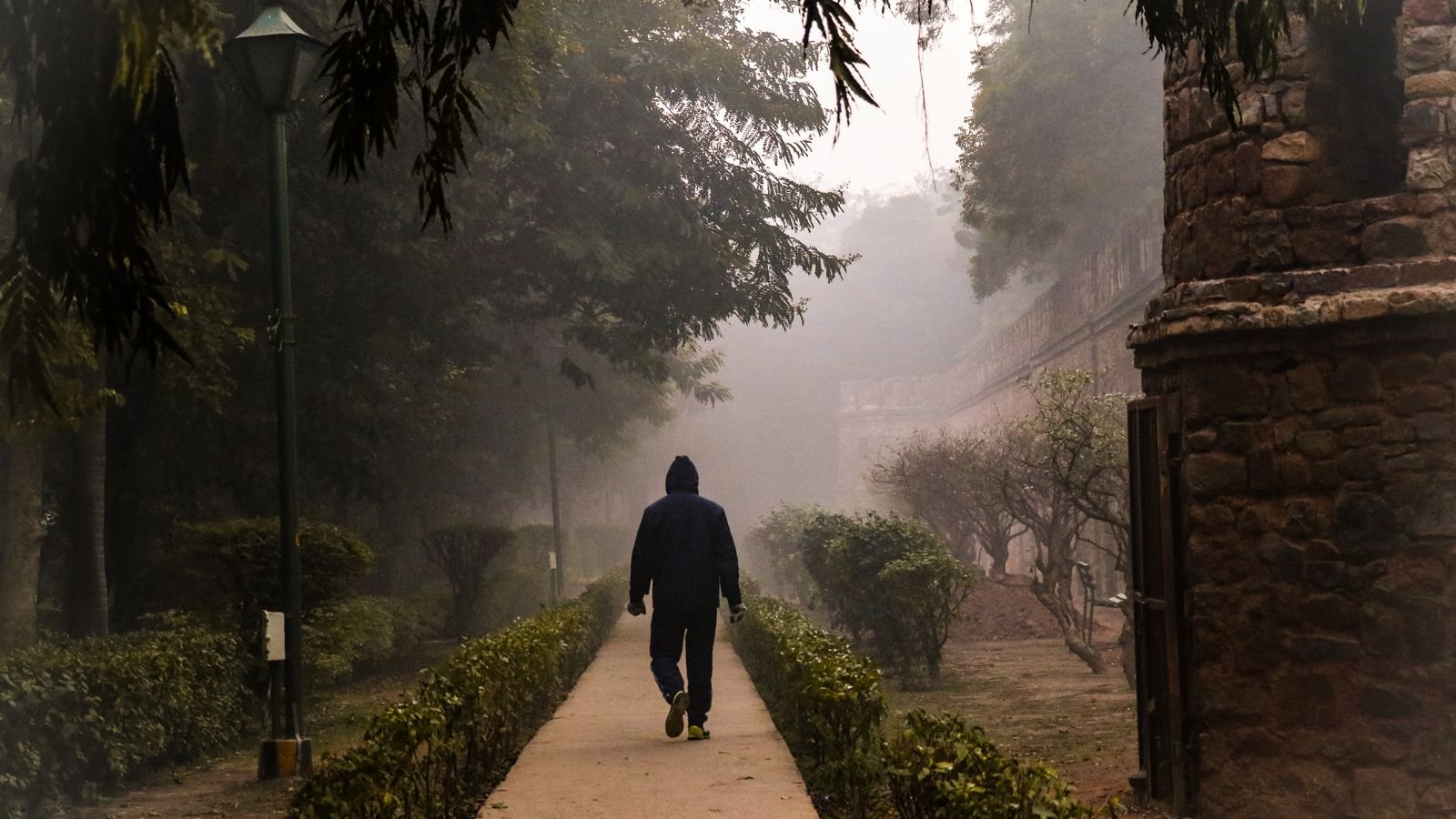
If your city’s AQI is “poor” or worse, don’t take your morning walk in pollution that bad. Move it indoors, or to later in the day. That’s what India’s health advisories say, and the research mostly backs them up. Delhi’s AQI was 321 at 7 am on 12 November, so this is a live question for anyone who walks in Delhi-NCR this week.
But the famous study people quote to say “exercise always wins over pollution” has a catch that changes the answer on a smoggy morning. I’ll get to it in section 2.
⚡ Key takeaways
- When the AQI turns bad, Delhi’s health department advises skipping outdoor morning and late-evening walks, jogging and exercise, especially on severe days.
- Over a year, the benefits of regular walking beat the harm from city air in almost every city studied, including Delhi.
- A single walk next to heavy traffic can cancel the short-term lung and artery benefits of walking, a London study found.
- There’s no magic “clean hour” in a North Indian winter. Check your nearest station’s live AQI before stepping out.
- Don’t stop moving. Shift the walk indoors on bad days and go back outside when the air improves.
What a High AQI Means for Your Walk
India’s National Air Quality Index, launched in October 2014, puts every reading into one of six bands. Each band comes with a short health note. Here’s what those notes say, as summarised on the government’s Arthapedia page:
| AQI band | Range | Official health note (short) | What I’d do with my walk |
|---|---|---|---|
| Good | 0–50 | Minimal impact | Walk anywhere, any time |
| Satisfactory | 51–100 | Minor discomfort for sensitive people | Walk as usual |
| Moderate | 101–200 | Discomfort for people with asthma, heart disease, kids and older adults | Walk, but stay off busy roads |
| Poor | 201–300 | Discomfort on prolonged exposure | Shorter, easier walk, or go indoors |
| Very poor | 301–400 | Respiratory illness on prolonged exposure | Move it indoors |
| Severe | 401–500 | Affects even healthy people, even during light activity | Stay indoors |
Look at the word “prolonged” in the poor and very poor rows. For comparison, WHO’s 2021 guideline for PM2.5 is just 15 µg/m³ averaged over 24 hours, and a “very poor” Delhi day sits far above that. A brisk walk makes you breathe harder and deeper, so 45 minutes of exercise is a bigger dose of air than 45 minutes sitting on a bench. That’s why the advice gets stricter for exercise than for simply being outside.
And Delhi isn’t the only city in these rows this week. On 12 November, The Week reported the city average at 323, with stations at IIT Delhi touching 416. The IMD didn’t expect rain to clear the haze soon.

The Big Study Says Walking Wins. Here’s the Catch
In 2016, researchers led by Marko Tainio at Cambridge asked a simple question: at what level of pollution does the harm from breathing dirty air cancel out the benefit of walking or cycling? Their study in Preventive Medicine modelled deaths from all causes across pollution levels from 5 to 200 µg/m³ of PM2.5.
The headline result is reassuring. At 100 µg/m³ of PM2.5, harm only overtook benefit after 1 hour 30 minutes of cycling a day, or more than 10 hours of walking a day. A normal half-hour walk came out ahead.
The Cambridge summary adds that only about 1% of cities in the WHO database were polluted enough for 30 minutes of daily cycling to do more harm than good. Delhi was one of the worst they modelled, and even there, the risk only overtook the benefit after about five hours of cycling a week.
Now the catch
Those numbers are long-term averages. The model looked at a year of typical pollution, not one smoggy November morning when the air near your colony can be far worse than the yearly average. The Cambridge summary itself notes that the model leaves out short-term pollution spikes and local conditions.
A different study tested the short term directly. In a 2018 Lancet trial, 119 people aged 60 and over walked for two hours on London’s busy Oxford Street on one day and in Hyde Park on another. The park walk improved lung function and reduced artery stiffness. On the traffic-choked street, those gains shrank or disappeared, and people with lung disease reported more cough and wheeze.
So both things are true. Walking is good for you over a lifetime, even in a polluted city. But one long walk through seriously bad air, next to traffic, can wipe out that day’s benefit. So keep walking, and get picky about which days and which routes.
 Also readWhy AQI Apps Show Different Numbers (and Which One to Trust)
What India’s Health Advisories Say
The official advice on exercise during smog hasn’t changed much in years.
When the Delhi government’s health department issued its winter advisory in 2023, it told people to avoid outdoor morning and late-evening walks, jogging, running and physical exercise, especially on severe AQI days, DT Next reported.
This year, the Union Health Ministry has written to states asking them to step up tracking of pollution-linked illness, ETV Bharat reported on 4 November. Public health expert Dr Tamorish Kole told the outlet that high-risk groups should be counselled on “reducing strenuous outdoor activity during poor air quality.”
Who counts as high-risk? Children, pregnant women, older adults and anyone with heart or lung disease. If that’s you or your parents, the threshold for staying in should be lower, not higher.
⚠️ Watch out
“I’ve walked in Lodhi Garden every morning for 20 years” isn’t a reason to keep going at AQI 400. The Severe band note says it can affect healthy people during light activity. Habits are great. Habits in bad air aren’t.
Morning Walk in Pollution: Is There a Best Time of Day?
In winter, not much of one.
An IndiaSpend analysis of CPCB data, republished by Scroll, found that in spring the cleanest time to be outdoors in Delhi was around 6 pm. In winter, the “best” hour shifted to about 7 am, but the margin was much smaller because cold, still air keeps pollution high through the whole day. That analysis is from 2015, so treat it as a pattern rather than a rule for this year.
Meanwhile, the advisories say to avoid both early morning and late evening. Put those together and you get a practical answer:
- Don’t go by the clock. Go by the number. Open a live AQI app and check the station nearest your home, not the city average.
- If the hourly reading near you drops into moderate (under 200), that’s your window, whatever the clock says.
- If it stays above 300 all day, skip outdoors entirely. Do the indoor routine in section 5.
Different apps show different numbers for the same street, which confuses everyone. Our guide to why AQI apps disagree and which one to trust explains which reading to go by.
💡 Pro tip
Fog and smog look much the same through a window, and winter haze is often a mix of both. The view won’t tell you the number, so check the reading before you judge the morning.
Indoor Swaps That Keep Your Walk Habit Alive
The worst outcome is stopping exercise for two months because “the air is bad.” The whole point of the Tainio study is that regular movement matters a lot. So swap, don’t skip.
At home (no equipment)
- Walk the house or the terrace stairwell. Ten minutes of brisk walking indoors, three times a day, adds up to the same 30 minutes.
- Climb stairs. A few floors up and down at a steady pace gets your heart rate up quickly. Hold the railing.
- A 10-minute bodyweight circuit: squats, wall push-ups, marching on the spot, step-ups on the bottom stair. Repeat twice.
- Yoga or a follow-along video on the TV. Free options on YouTube are endless.
Short bursts count more than people think. Our piece on the 4-minute exercise study explains what even short bouts of vigorous activity were linked to.
Outside the house
- Mall walking. Laps of a big mall before the crowds arrive. Dull, yes, but you’re off the road and moving.
- An indoor gym or sports hall, if you have access to one with the doors kept shut.
Make the room worth exercising in
Exercising indoors only helps if the indoor air is better. Keep windows closed during the worst hours (here’s when to open windows in pollution without letting the smog in), and if you have an air purifier, run it in the room where you work out.
 Also readSteps Per Day: Do You Really Need 10,000? What Studies Say

If You Take a Morning Walk in Pollution, Do It This Way
Some days the AQI sits in the 200s and you really want fresh air. Fair enough. These steps cut how much pollution you breathe in.
| Change | Why it helps |
|---|---|
| Pick a route away from main roads | The London trial found the traffic street blunted the benefits that the park walk delivered |
| Walk instead of run | Easier effort means slower, shallower breathing |
| Keep it shorter | The official notes all talk about “prolonged” exposure |
| Avoid peak traffic hours on your route | Less exhaust from vehicles right beside you |
| Stop if you feel breathless, wheezy or get chest discomfort | That’s your body telling you to go in |
A park is usually better than a roadside footpath. But a park right next to a highway isn’t, so think about what’s upwind of you, not just how green it looks.
Driving instead isn’t the clean escape it seems either. Air inside a car on a busy road can be worse than you’d think, which is why we wrote about using car AC recirculation in smog.
Who Should Be Extra Careful
For a healthy adult, a short walk on a “poor” day is a judgement call. For some people it isn’t.
- Children. The official AQI notes name them even in the moderate band. On bad days, see our guide on what parents can do when the AQI is high on a school day.
- Older parents. The London trial looked only at people over 60, and on the traffic street their walking benefits shrank or vanished.
- Pregnant women.
- Anyone with asthma, COPD or heart disease. The AQI notes call out these groups even in the “moderate” band.
If someone in your family falls in these groups, ask their doctor what AQI level should keep them indoors. It’s a two-minute question at the next check-up, and it gives you a clear rule instead of guessing every morning.
This article is for information only and isn’t medical advice. Consult a doctor about exercise if you have a heart or lung condition, are pregnant, or notice symptoms when you’re outdoors.
✅ Our verdict
Keep walking, but let the AQI decide where your morning walk in pollution season happens. Under 200, go out and pick a route away from traffic. Between 200 and 300, go shorter and easier, or stay in. Above 300, move the whole routine indoors until the air clears. Missing a few outdoor walks is fine. Giving up exercise for the whole winter isn’t.
Frequently Asked Questions
Is it safe to go for a morning walk when AQI is above 300?
Delhi’s health department advises avoiding outdoor morning walks, jogging and exercise when the air turns bad, especially on severe days. At 300+ (very poor), the official health note warns of respiratory illness on prolonged exposure. Walk indoors instead.
Is walking in pollution worse than not exercising at all?
Over the long term, research suggests regular walking still beats staying inactive in almost every city, including Delhi. On a single awful day, though, a long walk next to traffic can cancel that day’s benefit. Move it indoors rather than skipping it.
What is the best time for a walk in Delhi’s winter?
There isn’t a reliable clean hour in winter because still, cold air keeps pollution high all day. Check the live AQI at your nearest station and go when it dips below 200.
Is walking in a park better than on the road?
Usually, yes. A London trial found that people who walked in a park got lung and artery benefits that largely disappeared on a busy street. A park beside a major road is less helpful.
Does it help to walk slowly in polluted air?
Yes. An easier pace means you breathe less deeply, which lowers the amount of pollution you take in. Keeping the walk short helps too.
The Bottom Line
Your daily walk is worth protecting, smog or not. Make the AQI your morning check: under 200, walk outside away from traffic; above 300, take the walk indoors. Tomorrow morning, open an AQI app before your shoes, and look at the station nearest you.
Keep reading
 Read nextOpen Windows in Pollution? What to Do at Home When AQI Tops 400
 Read nextAQI on a School Day: What Parents Can Actually Do in Smog Season
 Read nextAir Purifier in Bedroom All Night? What a New Trial Found
Sources
- Tainio et al. 2016, Preventive Medicine: can air pollution negate the health benefits of cycling and walking? (Europe PMC abstract)
- University of Cambridge MRC Epidemiology Unit: summary of the Tainio study, Delhi and the 1% figure
- Sinharay et al. 2018, The Lancet: walking on Oxford Street vs Hyde Park in adults over 60 (Europe PMC abstract)
- Arthapedia (Government of India): National Air Quality Index bands and health impacts
- The Week: Delhi AQI 323 and station readings, 12 Nov 2026
- DT Next: Delhi health department advisory on morning walks and exercise (2023)
- ETV Bharat: Union Health Ministry letter to states and expert advice, Nov 2026
- Scroll / IndiaSpend: CPCB data on Delhi’s safest time to be outdoors by season (2015)
- WHO: 2021 air quality guidelines (PM2.5 annual 5 µg/m³, 24-hour 15 µg/m³)