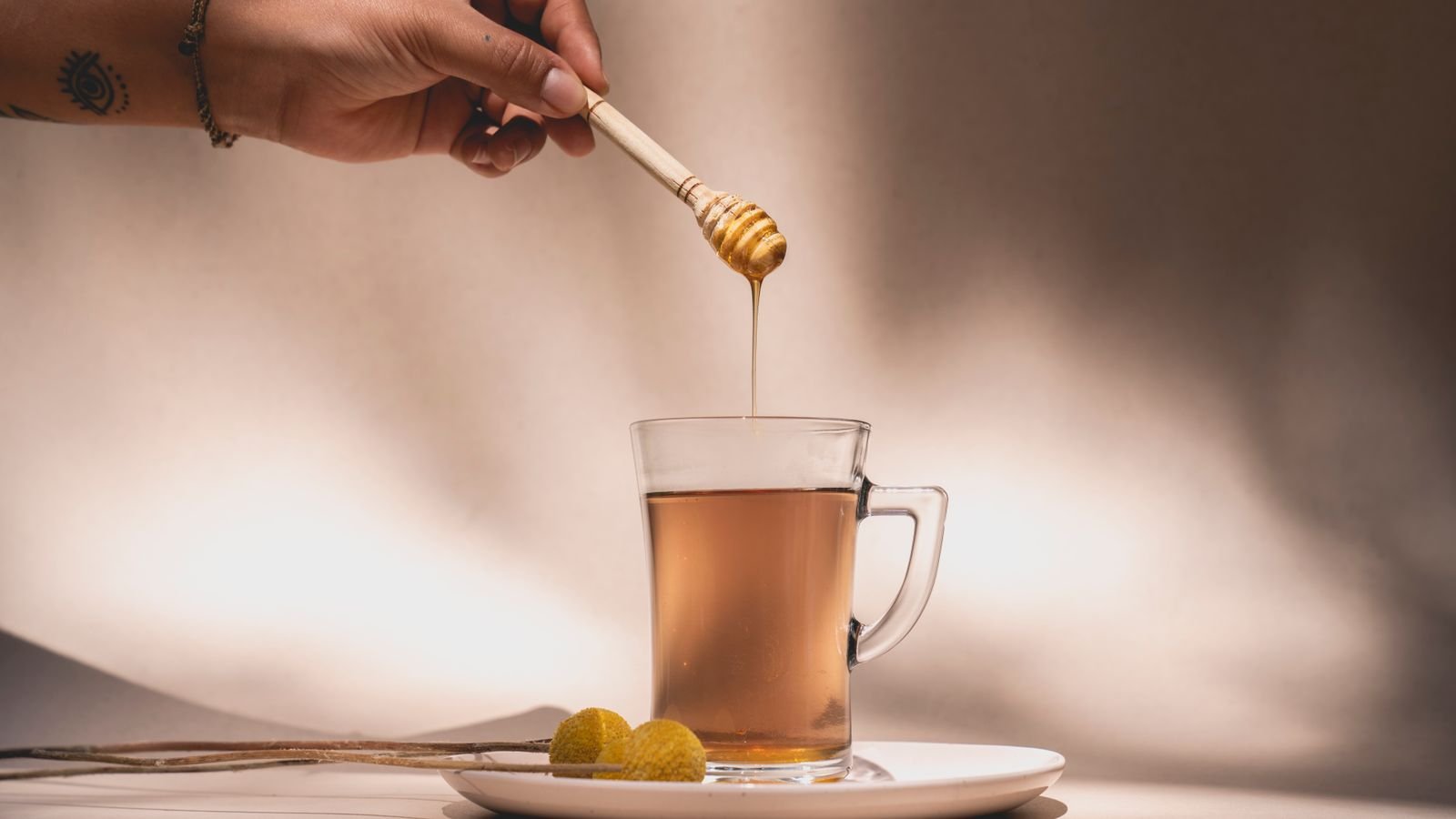
Honey in hot water does change the honey: heat creates a compound called HMF, so the old warning isn’t pure myth. But lab studies show only a small rise at the temperatures of a cup you can actually sip, and no human study shows that a spoon of honey in warm water harms you.
The bigger problems with your winter honey habit are less dramatic. Honey counts as sugar, spoon for spoon it carries more calories than white sugar, and a lot of the honey sold in India may not be pure honey at all. That last catch is in section 5, and no kitchen test will catch it.
⚡ Key takeaways
- Heating honey: HMF rises with heat and time. A 1973 study found only a slight rise at 50°C for 24 hours, and a 2010 rat study found no change in weight or organ weights after 6 weeks of heated honey.
- Simple fix: let the water cool until you can sip it, then stir in the honey. Don’t boil honey in kadha.
- Honey vs sugar: 1 teaspoon of honey has about 21 kcal; 1 teaspoon of sugar about 16 kcal (USDA). WHO counts honey as “free sugar”.
- The real catch: a 2020 CSE investigation found sugar syrup in 77% of honey samples it tested. Water, thumb and flame tests can’t catch modern adulteration.
- Never give honey to babies under 1 year (NHS: risk of infant botulism).
Why Honey in Hot Water Is a Winter Ritual
Walk into most Indian homes on a December morning and someone is stirring honey into a glass of warm water, maybe with a squeeze of nimbu. Honey goes into adrak chai, into kadha, and into ginger-tulsi mixes the moment anyone in the family coughs.
Alongside the habit comes a warning many of us grew up with: never heat honey, it turns into poison. That idea comes from Ayurveda. A 2010 paper in the journal AYU quotes the classical text attributed to Charaka, which says heated honey and honey mixed with an equal amount of ghee have harmful effects on the body. So which is it: healthy morning ritual or slow poison?
Neither, as it turns out. I went through the lab studies, the nutrition data and the purity investigations, and the answer is more boring and more useful than both extremes. Below are the four beliefs I hear most often, each checked against what the research found.
Belief 1: Honey in Hot Water Turns Toxic
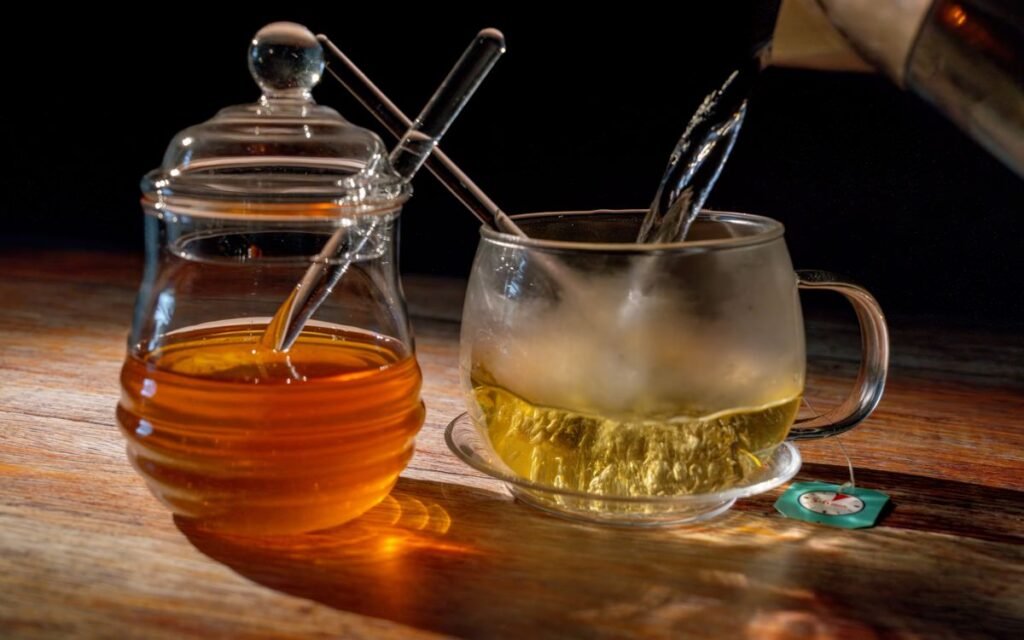
Partly true chemistry, wrongly scaled. When honey is heated, sugars like fructose break down into a compound called hydroxymethylfurfural, or HMF. Food scientists use HMF as a marker of how much heat or ageing honey has gone through.
What the studies found
- AYU journal, 2010: researchers heated honey to 60°C and 140°C. HMF rose significantly at both temperatures. They then fed rats heated honey, ghee, and honey mixed with ghee for 6 weeks. There was no significant change in food intake, weight gain or organ weights. The authors still concluded HMF “may cause deleterious effects”, but their own feeding test didn’t show harm.
- Hasegawa and colleagues, 1973 (Japan): heating honey at 50°C for 24 hours or 60°C for 10 hours gave only slight increases in HMF. Honey with lower pH made more HMF.
- A 2020 review on HMF toxicity (Molecules) notes that lab and animal studies have linked HMF to cell damage at high doses, but also that HMF is found in dried fruit, fruit juice, coffee, caramel and bakery products. Preserved fruits can hold more than 1 g per kg.
So HMF is real, and it’s not something only honey makes. A spoon of honey in hot water, stirred into a cup that has cooled enough to drink is heated for a few minutes, not 10 hours.
| What happens | Evidence | What it means for you |
|---|---|---|
| HMF rises with heat | Significant at 60°C and 140°C (AYU 2010) | Don’t boil or cook honey for long |
| Small rise at moderate heat | Slight at 50°C/24 h, 60°C/10 h (1973) | A sip-warm cup is a minor exposure |
| Harm in animals | No change in rats over 6 weeks (AYU 2010) | No proof of harm from normal use |
| Harm in humans | No human trials found | Unknown, so keep heating short |
💡 Pro tip
The easy rule: boil the water, wait 3 to 5 minutes until you can sip it comfortably, then stir in the honey. In kadha, add honey after you switch off the gas and the kadha has cooled a bit, not while it’s bubbling.
 Also readGinger in Winter: Does Adrak Really Keep You Warm?
Belief 2: Honey Is a Healthier Sugar
This belief does the most damage, because it makes people add more.
The USDA food database lists honey at 304 kcal per 100 g, with about 41 g fructose and 36 g glucose. White sugar is 387 kcal per 100 g. That looks like a win for honey until you measure by the spoon, which is how we actually eat it. Honey is denser, so a tablespoon weighs about 21 g against roughly 12.6 g for sugar.
| Per spoon (USDA data) | Honey | White sugar |
|---|---|---|
| 1 teaspoon | about 7 g, ~21 kcal | 4.2 g, ~16 kcal |
| 1 tablespoon | 21 g, ~64 kcal | ~12.6 g, ~49 kcal |
| Calcium per 100 g | 6 mg | 1 mg |
| Vitamin C per 100 g | 0.5 mg | 0 mg |
Yes, honey has a few minerals and traces of vitamin C. But 6 mg of calcium in a whole 100 g of honey is a rounding error, and you’d never eat that much in a day. Nobody should eat honey for nutrients.
WHO counts honey as sugar
The World Health Organization’s sugar guideline says adults and children should keep free sugars below 10% of daily energy, and ideally below 5%, which is roughly 25 g or 6 teaspoons a day. WHO’s definition of free sugars specifically includes “sugars naturally present in honey”. So the tablespoon in your morning water counts toward that limit just like the sugar in your chai.
Our post on jaggery vs sugar checks the same “natural sweetener” claim for gur, and the answer is similar.
Belief 3: Honey-Lemon Warm Water Burns Fat
This one lands in family WhatsApp groups every winter. I couldn’t find any good human trial showing that honey and lemon in warm water burns body fat. If you lose weight after starting it, the likely reason is that it replaced a sweeter breakfast or a second cup of sugary chai.
Do the maths the other way round. One tablespoon of honey a day is about 64 kcal. Over a month that’s roughly 1,900 kcal, all from sugar. That’s not a disaster, but it’s the opposite of a fat burner.
There’s one more small detail from the 1973 Japanese study. When researchers added citric acid (the acid in lemon) to honey before heating, HMF rose more than in honey without it, and the effect was stronger at higher temperatures. Those tests ran for hours, so your morning glass isn’t the same thing. Still, it’s one more reason to add honey and lemon to water that has cooled, not to a pan on the stove.
The warm water itself is fine. Many of us drink far too little in winter, and our guide on drinking water in winter explains how to tell if you’re getting enough. Plain warm water, or warm water with lemon and no honey, gets you the comfort without the sugar. If you love the taste of honey in hot water, keep it to one teaspoon.
The Real Catch: Is Your Honey Even Honey?
This is the part that worries me more than HMF. In December 2020, the Centre for Science and Environment (CSE) published an investigation of 13 honey brands sold in India, from big names to small ones. It’s an NGO investigation, not an FSSAI finding, but the numbers were striking.
What CSE reported
- 77% of samples were found adulterated with sugar syrup.
- Of 22 samples, only 5 passed all the tests.
- Most top brands passed India’s standard tests, including the C4 sugar test for cane sugar. But almost all failed a lab test called NMR (nuclear magnetic resonance) run in Germany.
- CSE said syrups sold under names like “fructose” were designed to beat standard purity tests, and suppliers claimed honey with 50 to 80% syrup could still pass.
- From 1 August 2020, NMR testing was made mandatory for honey meant for export.
⚠️ Watch out
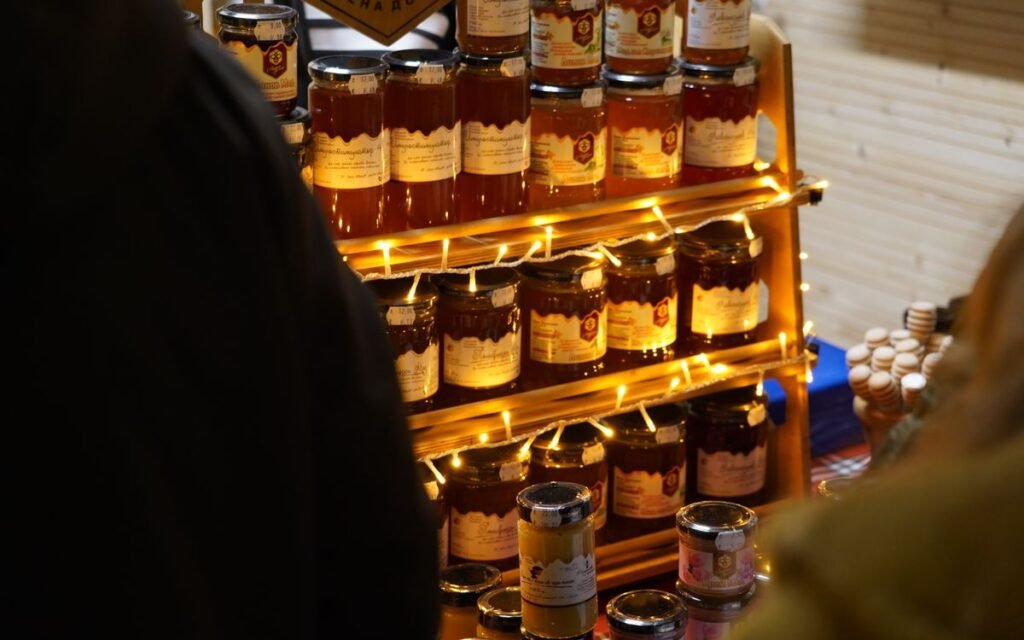
The water glass test, the thumb test and the matchstick flame test don’t work. Chemist Dr Peter Brooks of the University of the Sunshine Coast told ABC News that half the real honeys in his lab would probably pass these tests and half would fail, almost at random, and a good fake can’t be told apart. Crystallisation isn’t proof either: it depends mainly on the glucose-to-fructose ratio and storage temperature.
So what can you actually do? Buy from a seller you trust, check the pack for the FSSAI licence number and a batch number, and read the ingredients line. Anything that lists “sugar syrup”, “invert syrup” or “flavour” alongside honey isn’t pure honey. And honestly, if you’re paying for honey that may be part syrup, you’re paying a premium for sugar.
 Also readHow to Read Food Labels in India: A 60-Second Pack Check
Who Should Skip Honey (or Store It Better)
Honey is a normal food for most healthy adults in small amounts. But a few groups need to be careful.
- Babies under 1 year: never. The NHS says honey can occasionally contain bacteria that produce toxins in a baby’s intestines, causing infant botulism, which is a very serious illness. This includes the “bit of honey on the finger” tradition at naming ceremonies, and honey in janam ghutti.
- Children under 4: the NHS advises avoiding food and drinks with added sugar, and says this includes the natural sugar in honey, partly to protect teeth.
- Anyone managing blood sugar: honey raises blood sugar like any other sugar. If someone in your family has diabetes and adds honey “because it’s natural”, that’s worth raising with their doctor. Our Diwali sweets guide for diabetics covers the same “healthier sweet” trap.
- Anyone watching weight: count honey as sugar, not as a health food.
Store it in a cool spot
The same 1973 study found that honey stored below 10°C showed no HMF increase, honey at room temperature rose only slightly, but honey stored at 36°C showed an appreciable increase. In much of India, 36°C is an ordinary May afternoon. Keep honey in a closed jar in a shaded kitchen cupboard, away from the stove and sunny windowsills.
How to Take Honey in Hot Water, Sensibly
If you enjoy honey, keep it. Just change how you use it:
- Boil water, then let it cool for 3 to 5 minutes, until you can sip it without blowing.
- Use 1 teaspoon, not a heaped tablespoon. That’s about 21 kcal instead of 64.
- Count it in your day’s sugar. WHO’s ideal limit is about 6 teaspoons of free sugar a day, and honey is part of that.
- Add honey to kadha only after it’s off the flame and has cooled a little.
- Pick a trusted seller and read the label. Ignore home purity tests.
- Store it cool and shaded, lid closed.
- Keep it away from babies under 1, including in traditional rituals.
✅ Our verdict
Honey in hot water is fine for most healthy adults, as long as the water has cooled to sipping temperature and you treat the honey as sugar. The “heated honey is poison” fear is overblown for a normal cup. The real risks are quieter: extra calories, honey that’s partly syrup, and honey given to babies.
My honest take: the Ayurvedic instinct not to cook honey hard has some chemistry behind it, so there’s no harm in respecting it. But the bigger health win isn’t the water temperature. It’s using one spoon instead of three.
This article is for information only and is not medical advice. Please consult a doctor before using honey for any health condition, especially for children, during pregnancy, or if you have diabetes.
Frequently Asked Questions
Is it harmful to put honey in hot water?
Heating honey raises a compound called HMF, but studies show only a small rise at moderate heat, and a 6-week rat study found no harm. No human study shows that honey in a warm drink is harmful. To be safe, let boiled water cool until you can sip it before adding honey.
Is honey better than sugar?
Not by much. Honey has fewer calories per gram but more per spoon: about 21 kcal per teaspoon against 16 kcal for sugar, per USDA data. WHO counts honey as a free sugar, so it belongs in the same daily limit.
Does honey and lemon in warm water help weight loss?
There’s no good human evidence that it burns fat. A tablespoon of honey adds about 64 kcal a day. If it replaces a sweeter breakfast or sugary chai it may help a little, but on its own it adds calories.
How can I check if honey is pure at home?
You can’t, reliably. Scientists quoted by ABC News say the water, thumb and flame tests give near-random results, and crystallisation depends on the honey’s sugar mix. Lab tests such as NMR are needed, so buy from a trusted seller and read the label.
Can I give honey to my baby?
Not before 12 months. The NHS says honey can occasionally carry bacteria that cause infant botulism, a very serious illness. For children under 4, it also advises avoiding added sugars, including honey.
The Bottom Line
Honey in hot water isn’t poison, and it isn’t a superfood either. Let the water cool before adding it, use a teaspoon instead of a tablespoon, count it as sugar, and spend your worry on buying genuine honey and keeping it away from babies.
Next step: tomorrow morning, wait five minutes after boiling the water and halve your usual spoon of honey. If a parent takes it “for health”, check whether they have diabetes before it becomes a daily habit.
Keep reading
Read nextGinger in Winter: Does Adrak Really Keep You Warm? Read nextHaldi Doodh in Winter: What the Research Actually Says
 Read nextTil in Winter: How Much a Day, and Which Kind Has the Calcium
Sources
- Annapoorani et al., AYU 2010: heated honey, honey with ghee, HMF and a 6-week rat feeding study (PMC)
- Hasegawa et al., 1973: changes in HMF in honey with heating, storage temperature and added citric acid (J-STAGE)
- Farag et al., Molecules 2020: toxicological aspects of HMF and the foods it occurs in (PMC)
- WHO: guideline on free sugars, below 10% and ideally 5% of energy; honey counts as free sugar
- USDA FoodData Central: honey (FDC 169640) and granulated sugar (FDC 169655)
- NHS: foods to avoid giving babies and young children (honey and infant botulism, sugar under 4)
- CSE: honey adulteration investigation, December 2020 (77% of samples, NMR test)
- ABC News via inkl: scientists on why home honey purity tests don’t work (2018)